“Your parcel could not be delivered. Rebook for £1.49.”
Genuine courier, or the start of something?
Messages · situation 013Not because they’re careless.
150 everyday situations you don’t want to learn the hard way — suspicious calls, bank transfers, subscriptions, deliveries, renting, tradespeople, cars, travel, work, insurance and complaints. What to check, what to say, what to do next.
Print preorders dispatch 1 November 2026. UK postage included. Preorder now, or get the digital edition instantly.
Updated September 2026 · England-first edition.


The tricky part isn’t always spotting a scam. It’s the ordinary message that turns out to matter.
“Your parcel could not be delivered. Rebook for £1.49.”
Genuine courier, or the start of something?
Messages · situation 013“There’s fraud on your account. Move your money to a safe account now.”
Is this my bank, or someone who knows my bank?
Pause · situation 009“We’re deducting £700 from your deposit for cleaning and wear.”
Fair, negotiable, or not allowed?
Renting · situation 100A little checking changes everything.
Not every mistake is a scam. Not every confident refusal is the last word.
You don’t have to read it cover to cover. Look up the situation you’re in, get a clearer answer, and get on with your day.
“You can be polite and still ask for evidence.”
From the introduction to NOBODY’S MUGNot a translated handbook.
This book starts with how the money moved and what you agreed: card payment, bank transfer, Direct Debit, doorstep or online. Section 75, chargeback, the Consumer Rights Act 2015 and tenancy-deposit protection are explained where they actually apply, not as background theory.
From a suspicious text to a landlord’s deduction, it points you to the right route — an ombudsman, Citizens Advice, Action Fraud or a formal complaint — and the wording to use first. Each situation names its own scope: this edition is England-first, and some rules differ in Scotland, Wales or Northern Ireland.
1. Match the message against an actual order number in your own account. 2. Report a suspicious text to 7726 and a suspicious site to the NCSC. 3. If you entered card or login details, contact the card issuer and change any exposed or reused password.
Don’t assume a tiny fee means tiny risk. The page may be collecting card details, passwords or enough information for a later call.
THE IMPORTANT DISTINCTIONA real parcel and a false message can exist at the same time. Verification means starting from your order record, not examining the link more carefully.
WHAT TO SAY
“I’ll arrange delivery through my order account, not through this message.”
Excerpt from the September 2026 England-first edition. Read the full situation, the ‘if it doesn’t resolve’ step and source notes in the book. View this page
Thirteen parts. From “pause before you agree”
to “the next step”.
One situation per page. No hunting through a wall of text. Tap a page for a closer look.


Being nobody’s mug isn’t about suspecting everyone. It’s about working out what’s happening, finding the detail that matters, and taking the next useful step.
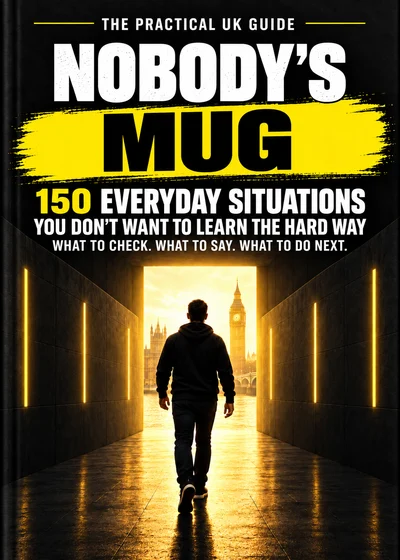
UK postage included. Estimated arrival: 3–7 working days after dispatch. Prices include any applicable VAT; the final total is shown before payment.
Printed book: 14-day right to cancel after delivery under UK law. Digital files: delivered immediately at your request, so the right to cancel ends once delivery starts. Read the policy.
Independent practical guidance, not individual legal, financial, or other professional advice. Source notes are organised by situation at the back of the book. Rules, amounts and procedures can change. Source review cutoff: 21 September 2026.
Anyone in the UK who’d rather check first than sort it out afterwards — suspicious calls and texts, bank transfers, subscriptions, deliveries, renting, tradespeople, cars, travel, work, insurance and complaints.
You can learn every lesson the hard way.
You don’t have to.
Print preorders dispatch 1 November 2026.
Digital files arrive by email within a minute.